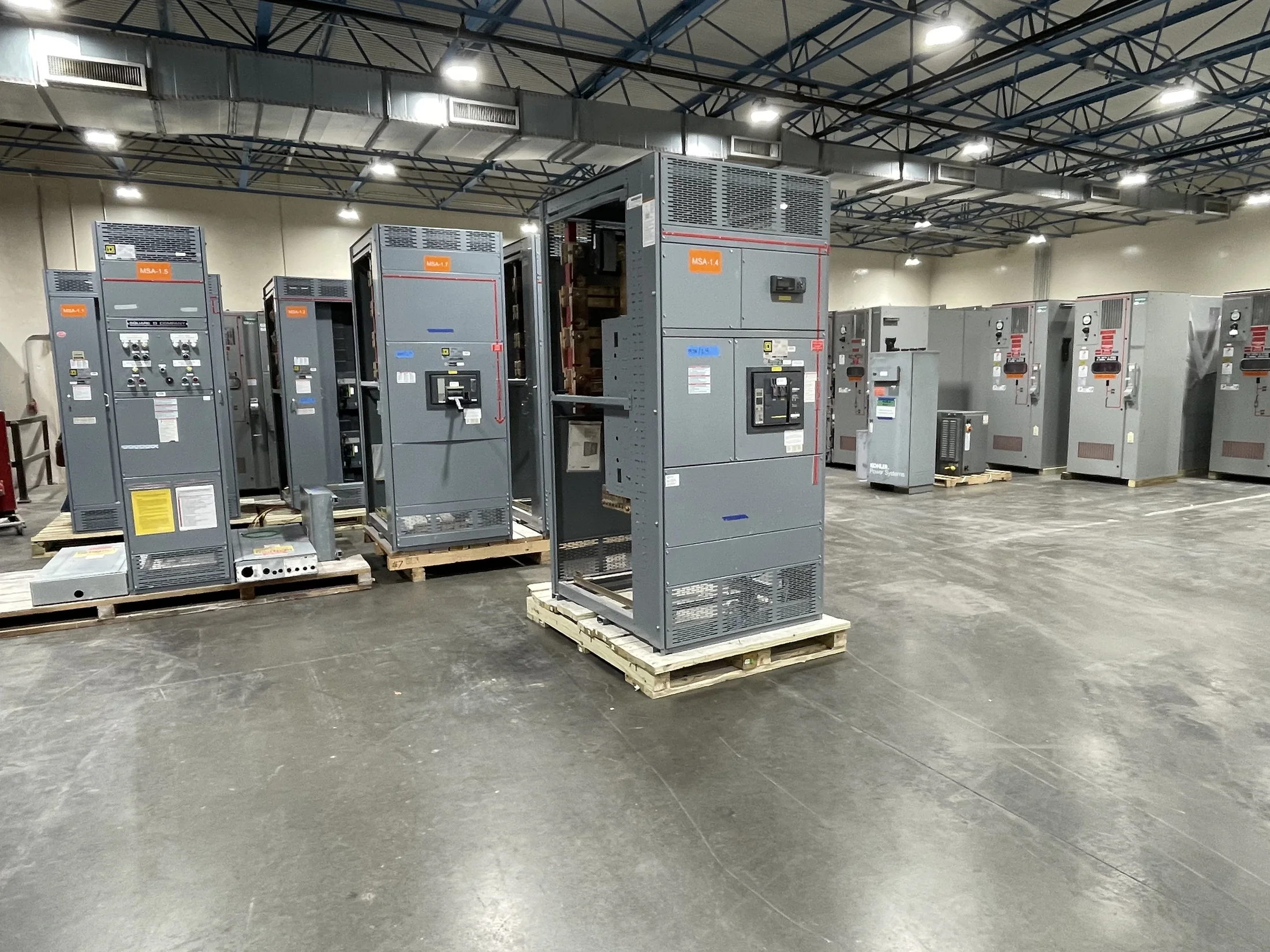
Start With the Production Process
Automotive supplier lines can combine conveyors, pumps, fans, machine tools, and process equipment, each with different starting and speed-control needs. Begin by identifying which motors require variable-speed drives, which operate across fixed speeds, and which loads must keep running during maintenance or a fault. These distinctions shape panel arrangement.
For Toledo projects, document the plant’s incoming service, available fault-current information, operating voltage, and any planned production expansion. Confirm these details with the responsible engineer and utility as applicable. A panel should be selected around the actual system and duty, not a presumed automotive-plant standard.
Account for Drive Heat Inside the Enclosure
Variable-frequency drives dissipate heat during operation, and losses depend on drive selection, loading, switching, and installation conditions. Multiple drives in a compact enclosure can raise internal temperature, affecting component selection and service life. The design team should evaluate heat from drives and associated components together, rather than sizing only for motor current.
Confirm ambient temperature, enclosure location, available clearance, dust or oil exposure, and whether the equipment sits near process heat. Cooling or ventilation provisions, if needed, must suit the environment and enclosure requirements. Provide drive quantities, ratings, and expected duty cycle so the manufacturer can assess a practical layout.
Evaluate Harmonics at the System Level
Drives draw nonlinear current, which can contribute harmonic distortion on the electrical system. The effect depends on the number and size of drives, their operating patterns, transformer and source characteristics, and other nonlinear loads. Assessing one panel in isolation may miss interactions with plant distribution or sensitive production equipment.
Ask the project engineer to establish the applicable harmonic assessment criteria and determine whether measurement, modeling, or mitigation is appropriate. Options such as line reactors, filters, or other system measures depend on the study and equipment configuration; they are not automatic features. Share existing studies and utility requirements when requesting a quote.
Coordinate Motor Feeders and Protection
Each motor feeder needs protection and switching selected for its circuit arrangement, motor, drive, and applicable electrical requirements. A drive’s input-side protective device is not interchangeable with motor overload protection, and the drive may provide functions that affect the coordination approach. Review the complete path from source to motor.
Confirm feeder conductor sizes, motor full-load data, starting and operating requirements, fault-current conditions, and the intended disconnecting means. Coordination and selective operation depend on the chosen devices and system study. Have the responsible engineer verify settings and protection so a fault on one branch does not create unwanted effects elsewhere.
Choose a Panel Architecture That Fits the Line
A drive panel may group multiple drives, provide separate motor feeders, or integrate with adjacent distribution equipment. The preferred arrangement depends on machine grouping, operator access, maintenance strategy, cable routing, and the consequences of taking a section offline. Consider whether spare space or provisions for future feeders are needed.
For new low-voltage distribution, distinguish a UL 891 switchboard from UL 1558 low-voltage switchgear; these are different equipment categories with different construction and application considerations. Medium-voltage equipment is a separate category. Confirm the required equipment type and applicable standards for the project rather than assuming a drive panel dictates them.
Plan Controls, Interfaces, and Maintainability
Drive-panel requirements extend beyond power circuits. Identify control voltage, hardwired interlocks, network protocols, remote speed references, alarms, and any interface with a plant control system. Define who supplies field devices and cabling, and document signal behavior for startup, communication loss, and emergency or process stops.
Review access for routine inspection, drive replacement, and cable termination, including clearances and working space established by the project design. Confirm labeling conventions, schematic expectations, and whether separate control sections or terminal arrangements are useful. These details help the manufacturer develop a build that supports commissioning and ongoing maintenance.
Prepare the Information for a Quote
A useful quote package includes a one-line diagram, load schedule, motor list, drive ratings, service details, available fault-current data, and project specifications. Include enclosure location and environmental conditions, required control interfaces, preferred equipment arrangement, and any harmonic study or coordination criteria already established.
Also identify the requested quantity, schedule needs, delivery destination, and review milestones. Note whether the scope includes only the panel or related distribution equipment, and state any customer-furnished components. Clear boundaries reduce assumptions; unresolved technical items can be listed for confirmation before design release rather than treated as guaranteed features.
Build for Toledo Delivery and Project Review
For Toledo-area automotive suppliers, coordinate panel dimensions, conduit entry, shipping access, and installation sequence with the contractor and facility team. Confirm the receiving location and any restrictions on unloading or staging. Nationwide shipping supports projects beyond Ohio as well, while project-specific delivery arrangements should be established during quotation.
The manufacturer builds new equipment in the United States using American components and offers custom fabrication for defined project requirements. Short lead times may be available, but schedule depends on scope, component availability, engineering review, and approvals. Have the responsible engineer, utility, and AHJ review applicable design details before release and installation.