Start with the Toledo load profile
Industrial demand can vary sharply between steady process loads, batch operations, motor starts, and seasonal production. Before selecting equipment, gather the connected-load schedule, measured peak demand where available, anticipated expansion, and the operating sequence of major loads. Those inputs help the engineer distinguish normal operating demand from brief starting or coincident peaks.
Identify critical loads and the consequences of an interruption, including process controls, safety systems, refrigeration, pumps, and production lines. Note planned redundancy, transfer schemes, and any loads expected to operate during maintenance. A useful equipment basis reflects actual operating priorities rather than simply adding nameplate ratings or assuming every load runs simultaneously.
Coordinate voltage and service conditions
The serving utility and project engineer establish the service voltage, available fault current, grounding arrangement, and point of delivery. Confirm these early, along with metering requirements and the utility's service rules. The selected assembly must suit the documented system conditions; assumptions based on another Toledo facility can lead to a mismatched design.
For low-voltage distribution, determine whether the project calls for a UL 891 switchboard or UL 1558 low-voltage switchgear. These are distinct equipment categories, and the appropriate choice depends on the application and design requirements. Medium-voltage service requires equipment designed for that voltage class; neither UL 891 nor UL 1558 should be treated as a medium-voltage standard.
Translate interconnection inputs into a design basis
Projects adding generators, solar, battery storage, or other parallel sources need a defined interconnection scope. Collect utility-approved one-lines when available, source ratings, operating modes, proposed protective functions, and the intended point of connection. Confirm who is responsible for protection coordination, metering, transfer logic, and any utility-required interface equipment.
Interconnection requirements depend on the utility, system configuration, and project approval process. Do not treat a preliminary application or equipment quote as authorization to parallel with the grid. The responsible engineer should reconcile utility comments and approved settings with the final drawings, while the authority having jurisdiction reviews matters within its scope.
Account for the installation environment
Toledo-area installations may face changing temperatures, humidity, dust, process residue, vibration, or water exposure, depending on the building and location. Document indoor or outdoor placement, room ventilation, elevation, nearby heat sources, corrosive agents, and cleaning practices. Enclosure and construction choices should follow the actual exposure, not a broad assumption about the city.
Provide equipment-room dimensions, access routes, floor and wall constraints, cable entry preferences, and working-clearance requirements. Check doors, overhead obstructions, lifting access, and equipment handling paths before fixing the lineup arrangement. The project engineer should verify applicable code, environmental, and access requirements for the site and installation.
Choose a workable lineup and distribution arrangement
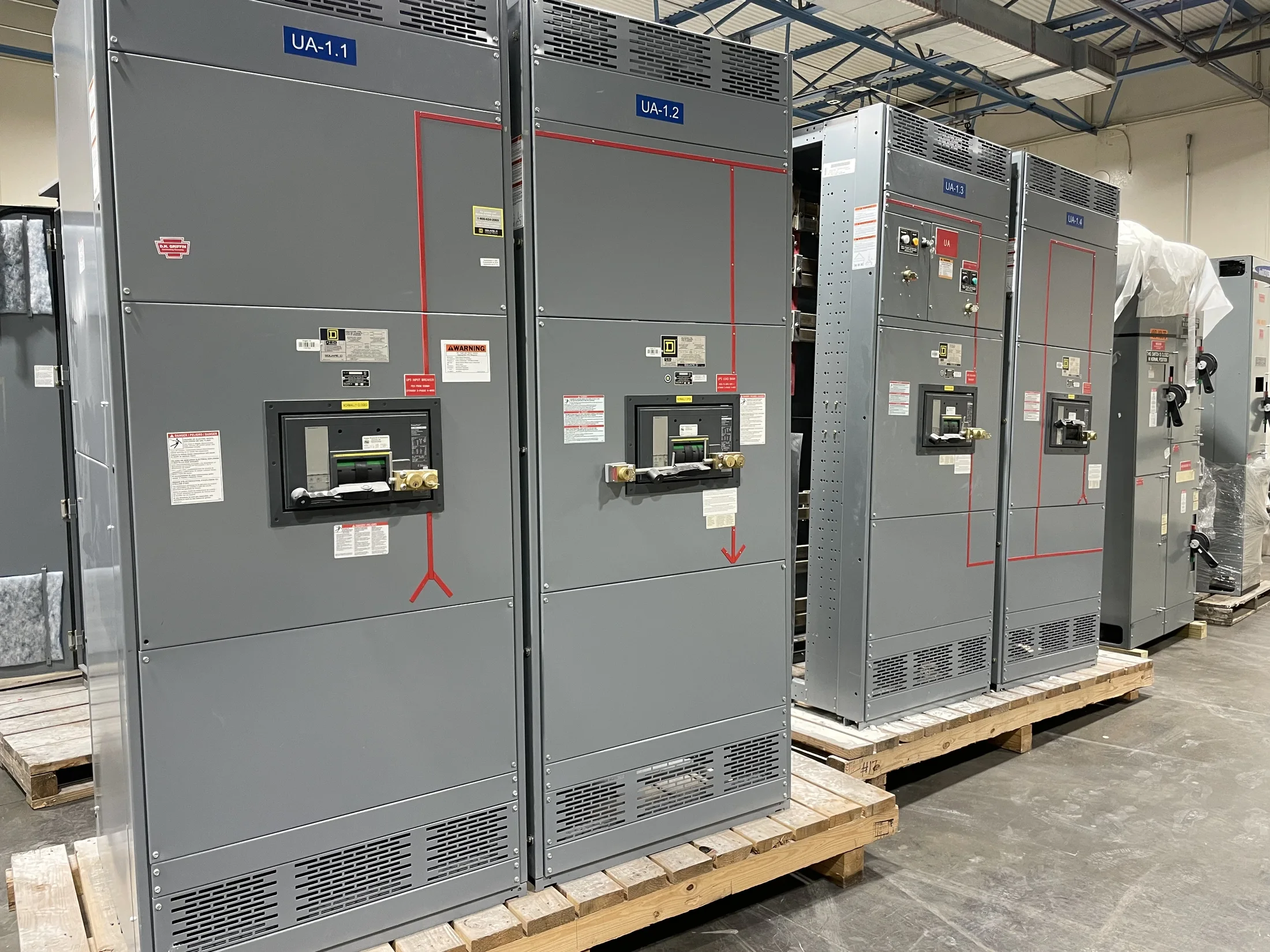
A lineup may need main, feeder, tie, or section devices arranged around the facility's distribution plan. Identify downstream panelboards, transformers, motor control centers, and large loads, then specify feeder quantities and termination needs. The required bus arrangement, compartmentation, and metering provisions should be confirmed against the one-line and operating plan.
Future capacity is a design decision, not an automatic feature. Specify spare spaces, planned feeder additions, and expected load growth so the builder can assess a practical configuration. Confirm cable sizes, entry direction, lug provisions, and termination space with the engineer and installing contractor before releasing drawings for fabrication.
Resolve protection, coordination, and control details
Gather protective-device settings or the information needed to develop them, including utility fault-current data, transformer impedance, conductor lengths, and downstream device details. Coordination and arc-flash studies are project-specific engineering work. Their results can affect device selection and settings, so the responsible engineer should review the proposed equipment against study requirements.
List control power, alarms, communications, metering, and remote-operation needs explicitly. Identify protocols, points lists, source requirements, and interfaces with facility systems where applicable. Avoid assuming that a particular relay function, communication option, or control scheme is included; confirm the required components and responsibilities in the project documents.
Prepare quote inputs that reduce design uncertainty
A useful quote package includes the one-line diagram, load schedule, service data, fault-current information, equipment location, dimensional constraints, and requested equipment standards. Add feeder and device schedules, environmental conditions, interconnection documents, and target project milestones. Mark preliminary information clearly and identify open decisions so they can be addressed before final design.
Also state the intended application, quantity, preferred configuration, drawing requirements, and delivery destination. If the utility or engineer has issued comments, provide the latest version and note unresolved items. Complete inputs help evaluate a buildable scope and short lead times, but timing depends on design completeness, component availability, approvals, and fabrication requirements.
Build, review, and deliver for the project
We manufacture new switchgear and power distribution equipment in the United States using American components, with custom fabrication for project-specific requirements. For Toledo facilities, equipment selection and drawings should be reviewed against the approved electrical design before production. Confirm requested ratings, construction details, documentation, and any applicable listing or approval requirements for the particular build.
Nationwide shipping supports delivery to Toledo and projects elsewhere, but site readiness remains part of the installation plan. Coordinate receiving, storage, handling, setting, terminations, and field verification with the contractor and responsible engineer. Utility coordination and AHJ review may also be needed; confirm local requirements and final design acceptance before energization.