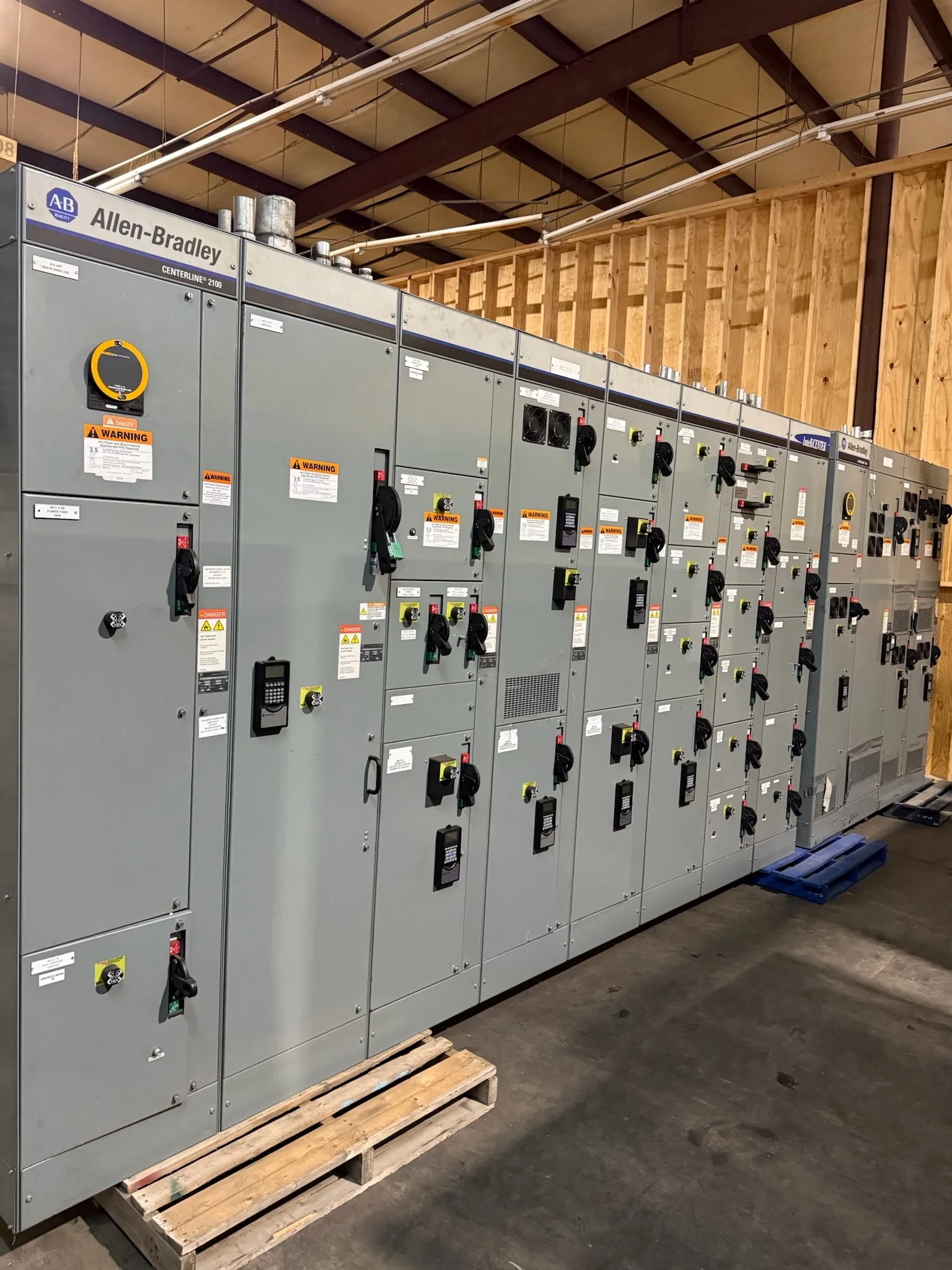
Define the Schedule’s Purpose and Boundaries
Begin by identifying what the schedule must support: a new facility, an expansion, a replacement lineup, or a defined portion of a plant. Set the electrical boundaries, such as utility service, transformers, main distribution, and downstream panels. Without a clear boundary, loads can be omitted or counted twice.
Record the applicable one-line drawing, nominal voltage, phase, frequency, and grounding arrangement when known. Distinguish existing loads from proposed additions, and identify which distribution sections are in scope. The responsible engineer should resolve system basis and code requirements; a manufacturer needs these inputs to evaluate a suitable new equipment configuration.
Build a Verifiable Connected-Load Inventory
For each load, capture equipment tag, description, quantity, location, served process, and electrical nameplate data. Useful values may include voltage, phase, horsepower or kilowatts, rated current, power factor, and motor starting method. Attach schedules, cut sheets, or photographs where available, and flag estimated or missing values rather than presenting them as confirmed.
Separate individual loads from package equipment. A packaged machine may contain motors, heaters, controls, and auxiliary devices with different operating patterns; use supplier data or an agreed package input instead of adding nameplate values blindly. Note spare circuits separately from actual connected loads, and identify loads supplied from another source to prevent duplicate entries.
Document Demand Assumptions Transparently
Connected load is an inventory, not necessarily the expected coincident demand. For each group, state the demand factor, diversity assumption, or calculation method and its basis. Identify which loads can operate simultaneously, which are mutually exclusive, and whether the estimate reflects normal production, peak production, startup, or another defined condition.
Avoid applying a single reduction factor to unlike loads without engineering justification. A continuous process, intermittent welders, office receptacles, and standby auxiliaries may have materially different use patterns. Show assumptions by load category or operating scenario, retain calculation notes, and have the responsible engineer verify applicable code provisions and utility service criteria.
Represent Duty Cycles and Operating Scenarios
Describe operating hours, shifts, starts per hour, seasonal use, and typical on-time for significant loads. For motors and process equipment, note whether operation is continuous, cyclic, batch-based, or standby. Include sequencing information where several large loads start together or where controls limit concurrent operation; these details can change the practical demand basis.
A single maximum-demand number may conceal important conditions. Consider normal operation, production peak, equipment startup, maintenance bypass, and emergency operation where relevant to the project. Identify which scenarios are credible and which are prohibited by controls or procedures. The engineer should determine whether the schedule also supports voltage-drop, starting, or generator studies.
Identify Load Characteristics That Affect Distribution
Beyond kilowatts and amperes, flag loads with characteristics that may affect equipment selection or system studies. Examples include large motors, variable-frequency drives, rectifiers, UPS systems, welders, electric heating, and nonlinear electronic loads. Provide available manufacturer data for input current, starting current, harmonics, or power factor; do not substitute assumptions for missing data without labeling them.
Record anticipated fault-current information, protective-device coordination requirements, and any known selective-coordination or arc-energy study criteria separately from load totals. These factors influence design and device selection but cannot be established by summing connected loads. The responsible engineer, utility, and AHJ should confirm applicable system and installation requirements for the project.
Set a Defensible Future-Capacity Allowance
Define future capacity by specific plans where possible: named process additions, reserved feeder positions, expected production increases, or a stated planning horizon. Distinguish forecast demand from installed spare capacity. A percentage allowance may be useful, but document its basis and avoid applying it indiscriminately to every load or treating it as a guaranteed usable reserve.
Translate growth plans into physical and electrical questions: anticipated feeder count, breaker spaces, bus capacity, room for future sections, and likely voltage or fault-duty changes. A provision for spaces does not itself establish capacity. Confirm that the switchboard or switchgear design, upstream source, conductors, and available space can support the intended additions.
Check the Schedule Against the Distribution Design
Reconcile the load schedule with one-line diagrams, panel schedules, equipment lists, and control narratives. Check quantities, voltage levels, feeder destinations, and transformer assignments; investigate unexplained differences before equipment sizing proceeds. Mark values as confirmed, estimated, or pending, and maintain revision dates so later scope changes do not silently invalidate the design basis.
The engineer should evaluate calculated demand alongside continuous-load rules, conductor and overcurrent protection requirements, motor provisions, voltage drop, and available fault current. Equipment selection depends on the complete system and application, not the schedule total alone. Applicable product standards also depend on equipment type: UL 891 switchboards differ from UL 1558 low-voltage switchgear and medium-voltage equipment.
Prepare a Quote-Ready Information Package
For a manufacturer’s quotation, provide the current load schedule, one-line diagram, project voltage and phase, system grounding, estimated demand, and requested equipment scope. Include load categories, major motor and drive data, future allowances, incoming-source details, feeder quantities, and known space constraints. Identify the project location and expected procurement milestones without assuming a delivery date.
List unresolved items explicitly, including pending utility data, equipment cut sheets, fault-current values, or final feeder assignments. State whether the request concerns a new switchboard, low-voltage switchgear, or medium-voltage equipment, and note any required enclosure or access conditions for evaluation. U.S. manufacturing, domestic components, custom fabrication, short lead times, and nationwide shipping can support projects; confirm project-specific requirements and availability with the manufacturer.