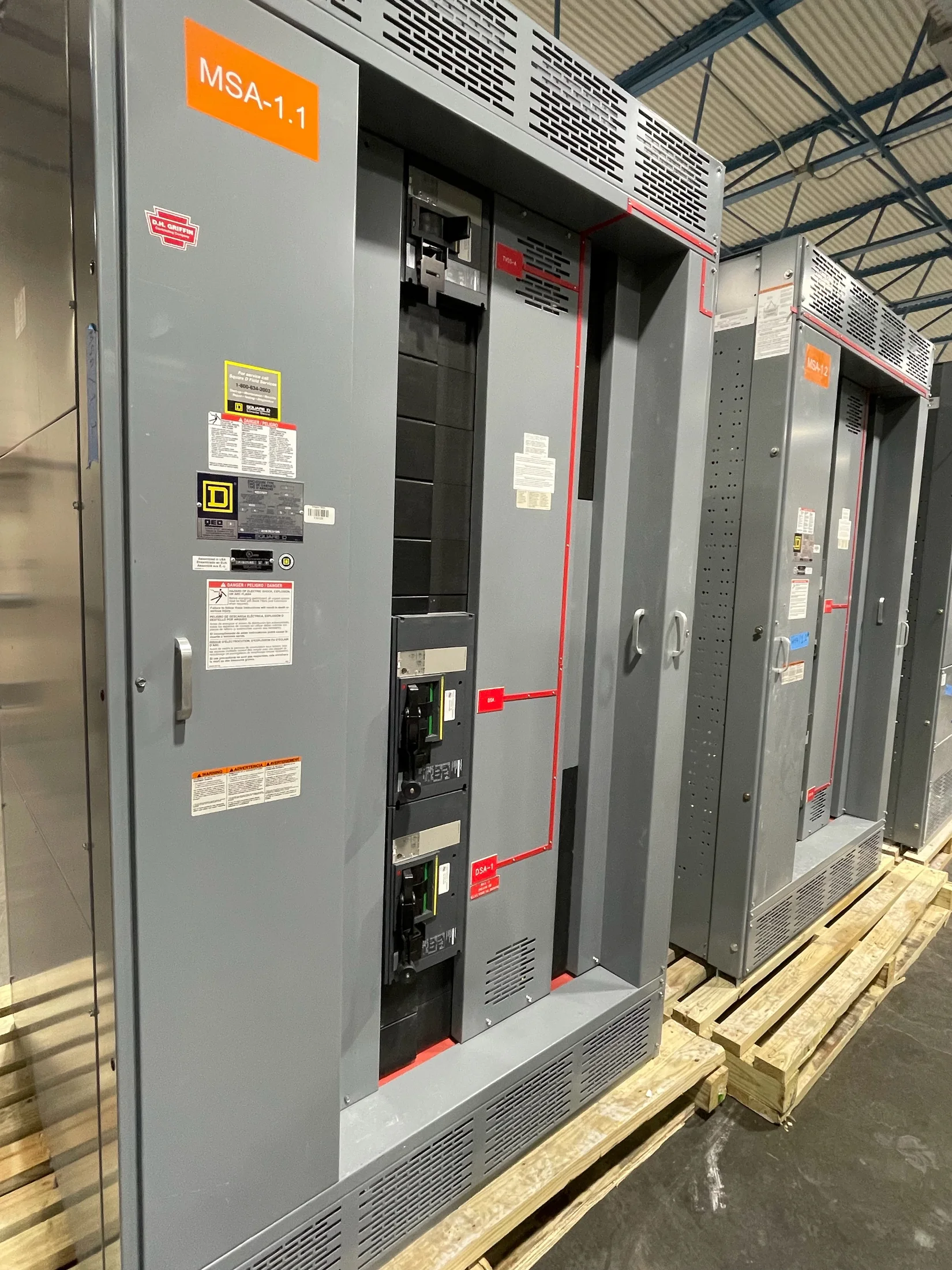
What an Assembly Rating Tells You
An assembly short-circuit current rating states the maximum fault-current level the equipment is rated to withstand or interrupt under defined conditions. It is not a prediction of the current that will flow during every fault. Rather, it is a limit used to evaluate whether the specified assembly is suitable for its intended electrical system.
The rating applies to the assembled configuration, not simply to a cabinet or a single breaker considered by itself. Bus structure, protective devices, connections, and other components can affect the applicable rating. Confirm the rating and its conditions for the exact equipment lineup and arrangement being proposed.
Compare It with Available Fault Current
Available fault current is the prospective short-circuit current that the power system can deliver at a particular point. It depends on the source, transformer characteristics, conductors, and system configuration. Because impedance changes along the distribution path, the available current at service equipment may differ from the value at a downstream panel.
For selection, compare the calculated available fault current at the equipment terminals with the assembly rating applicable to the proposed configuration. The rating must not be treated as interchangeable with a nominal voltage or continuous current rating. Have the responsible engineer confirm the calculation basis and the point to which it applies.
Establish the System and Connection Point
A useful short-circuit study begins with the actual supply arrangement. Identify utility source information, transformer kVA and impedance, primary and secondary voltages, conductor lengths and sizes, and any generators or other sources that can operate in parallel. Operating modes may change fault contribution, so document relevant normal and alternate configurations.
The equipment location matters: service entrance, generator paralleling point, and downstream distribution positions can have different calculated values. Provide the one-line diagram and identify the intended connection point when requesting a quote. Where utility data or operating assumptions are uncertain, coordinate with the utility and responsible engineer before finalizing the specification.
Configuration Can Change the Applicable Rating
Short-circuit capability is tied to the selected equipment arrangement. Main and feeder devices, bus ratings, protective-device type, and the way sections are connected can determine which assembly rating applies. A change in breaker model, main-device arrangement, or lineup design may require a different rating review rather than a simple substitution.
Some designs rely on a tested or otherwise established combination of protective devices and assembly components. Do not assume that a higher-rated individual breaker automatically gives the complete lineup that rating. Confirm the proposed combination, any required upstream device, and applicable conditions in the manufacturer’s equipment documentation and project submittals.
Coordinate Protective Devices and System Studies
Protective-device selection and coordination influence how fault current is cleared, but coordination goals do not replace an adequate assembly rating. Engineers should review available fault current, device interrupting ratings, protection settings, and the equipment’s marked rating together. A current-limiting device may affect a documented combination, but its effect must be supported for that application.
Arc-flash analysis and short-circuit analysis address related but distinct questions. The fault-current value and clearing time used for incident-energy calculations should reflect the specified system and protective-device settings. Confirm study assumptions against the final equipment configuration, and resolve discrepancies with the responsible engineer before releasing equipment for manufacture.
Keep Equipment Standards Distinct
For low-voltage distribution, UL 891 applies to switchboards, while UL 1558 applies to low-voltage metal-enclosed switchgear. These are distinct equipment categories; selection should follow the project’s functional, construction, and specification requirements. The applicable assembly rating must be confirmed for the particular product type and configuration rather than inferred from the standard’s name.
Medium-voltage equipment is a separate category with its own applicable standards and rating considerations. UL 891 does not cover medium- or high-voltage equipment. Identify system voltage and equipment class early so the specification, fault study, and equipment documentation address the correct product family and applicable requirements.
Information to Provide for a New Equipment Quote
For a technically useful quote, provide the system voltage, phase and frequency, continuous-current requirements, requested short-circuit rating, and available fault current at the installation point with its source. Include the one-line diagram, utility or transformer data, service configuration, and any generator or alternate-source operating modes that affect fault contribution.
Also identify the equipment category, service-entrance requirements, main and feeder arrangement, metering needs, enclosure conditions, and applicable project specifications. State whether the rating is based on a completed study or a preliminary value. These details help define custom fabrication and clarify which assumptions require engineering confirmation.
Verify Before Approval and Installation
Before approving submittals, compare the documented assembly rating with the latest available fault-current study and the project’s specified operating modes. Check that device selections and any stated conditions match the submitted lineup. If the utility changes source data, or a transformer or conductor design changes, request review because the calculated available current may also change.
The manufacturer builds new switchgear and power distribution equipment in the United States with American components, offers custom fabrication, short lead times, and nationwide shipping. Confirm project-specific ratings, construction details, and documentation during quotation and submittal review. The responsible engineer, utility, and authority having jurisdiction should resolve design and installation requirements.