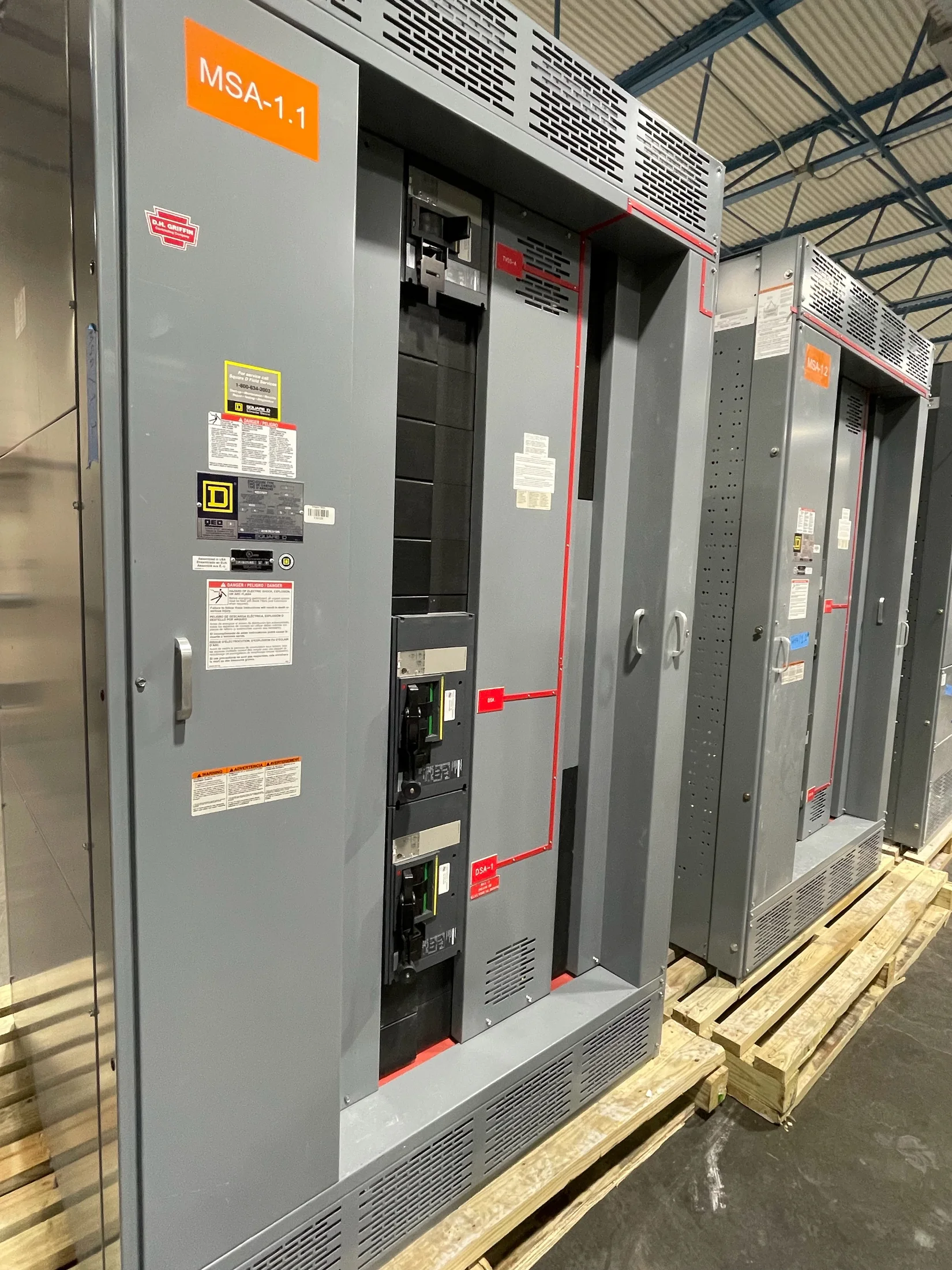
Start with the Actual Source Frequency
In the United States, utility power is generally 60 hertz, but a facility can also use generators, frequency converters, or equipment supplied for international applications. Confirm the frequency at the point where the new distribution equipment will connect. Do not infer it from the project location, voltage, or a previous equipment schedule.
For a new switchboard or switchgear order, provide the nominal system frequency and identify any alternate operating source. If a facility may transfer between utility and generator power, verify that both sources have compatible frequency, voltage, phase sequence, and grounding arrangements. The responsible engineer should resolve discrepancies before equipment design and component selection.
Frequency and Breaker Application
A circuit breaker’s suitability depends on more than its ampere rating. Confirm the manufacturer’s application data for the intended frequency, voltage, interrupting duty, and operating conditions. Frequency can affect interruption behavior and the applicability of ratings or test data, particularly when equipment designed around one frequency is proposed for another.
Specify breaker type, poles, frame and trip requirements, system voltage, available fault current, and frequency. Do not assume a breaker’s familiar label or a similar catalog number establishes suitability at 50 or 60 hertz. The responsible engineer should check the selected device’s published data and coordination requirements for the actual system.
Transformer Frequency and Magnetic Design
Transformer frequency is integral to magnetic design. A transformer intended for one frequency may not be interchangeable at another, even when its voltage and kVA appear to match. Core flux, heating, losses, and permissible operation depend on the relationship among applied voltage, frequency, winding design, and the manufacturer’s specified limits.
For quotation, provide primary and secondary voltages, kVA, connection and grounding needs, load characteristics, and nominal frequency. Identify whether operation at more than one frequency is required and whether the transformer is part of the supplied assembly. Have the engineer verify suitability using the transformer manufacturer’s data rather than relying on voltage ratio alone.
Meters, Sensors, and Measurement Accuracy
Metering devices must support the system frequency and the measurement functions required by the application. Confirm the meter’s frequency range, accuracy conditions, voltage inputs, current-transformer inputs, and configuration options. A meter that displays basic voltage or current may not provide accurate power, energy, or power-quality readings under every frequency condition.
Provide the desired readings, communications protocol, display or remote-monitoring needs, and whether the meter measures a single source or multiple sources. Include system voltage, phase configuration, and frequency in the instrument schedule. If readings support billing, protection, or compliance decisions, specify the required accuracy and have the responsible engineer confirm the complete measurement chain.
Protective Relays and Frequency Functions
Relay compatibility includes both the frequency of voltage and current inputs and the relay’s available protection functions. Some applications require underfrequency or overfrequency elements, while others need only conventional overcurrent protection. Settings, sensing methods, response characteristics, and coordination must fit the system and its operating modes.
For a relay quote, identify the protected equipment, nominal frequency, source arrangement, CT and VT ratios, required functions, trip logic, communications, and control power. Note generator operation, load shedding, or transfer schemes where applicable. Relay settings are not established by equipment fabrication alone; the responsible protection engineer must develop and review them for the installation.
Control Power, Coils, and Auxiliary Devices
Control circuits can have frequency-dependent components, including AC coils, power supplies, timers, and sensing devices. Verify each device’s input voltage and frequency range, especially when the control source differs from the main power source. A control transformer’s output voltage does not by itself prove that connected devices are suitable for the incoming frequency.
Schedules should state control-power source, AC or DC requirements, nominal voltage, frequency where applicable, and any required ride-through or sequencing behavior. Identify interface signals and devices furnished by others. These details help configure a new assembly consistently, but project-specific compatibility remains subject to component documentation and the engineer’s review.
Mixed-Frequency Sources and Conversion
Facilities may have a 60-hertz utility supply alongside equipment served by a converter or another source. Treat each electrical section according to its actual source frequency; do not assume one frequency applies throughout the facility. Clearly mark boundaries between systems and identify loads that may operate on more than one source.
Where transfer or conversion is involved, confirm the converter’s input and output characteristics, bypass arrangement, grounding, fault contribution, and behavior during transitions. Verify that breakers, transformers, meters, relays, and controls are compatible on each side. The utility, responsible engineer, and authority having jurisdiction may need to review the proposed arrangement and protection.
Information to Include in an Equipment Quote
A useful request for quote includes nominal frequency, system voltages, phases, grounding method, one-line diagram, source details, and operating scenarios. Add load and fault-current information, breaker requirements, transformer data, metering functions, relay functions, and control-power needs. Flag any 50-hertz equipment or mixed-frequency sections rather than leaving those conditions implicit.
The manufacturer builds new switchboards, low-voltage switchgear, and power distribution equipment in the United States using American components, with custom fabrication, short lead times, and nationwide shipping. Equipment scope and component selection depend on confirmed project requirements. UL 891 switchboards and UL 1558 low-voltage switchgear are distinct categories; neither designation establishes frequency compatibility for every component.