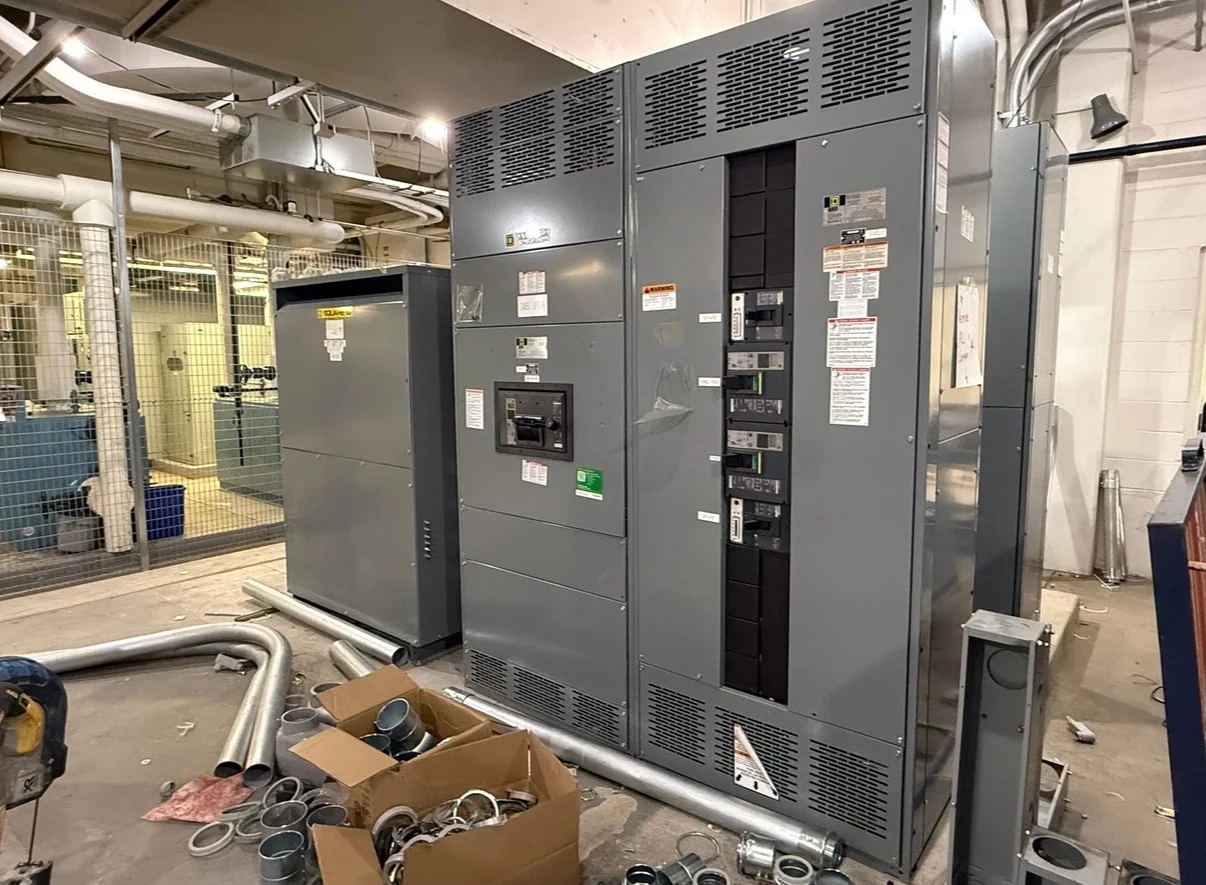
Where Air Circuit Breakers Fit
Air circuit breakers are commonly selected for low-voltage service entrances, main-tie-main arrangements, and large feeder positions where a drawout breaker and adjustable protection may suit operating or maintenance practices. Their application depends on the system voltage, available fault current, load profile, and coordination requirements—not simply the ampere rating printed on a one-line diagram.
Air circuit breaker switchgear generally refers to low-voltage switchgear assemblies using these breakers; it is distinct from UL 891 switchboards and from medium-voltage equipment. The responsible engineer should establish the applicable product standard, assembly type, and project requirements. Confirm the intended installation and specification before requesting a manufacturer-built configuration.
Establishing the Breaker Current Rating
Begin rating selection with the calculated continuous load, expected growth, and applicable design rules. Account for load diversity only when the project’s engineering basis supports it. A breaker frame rating and its sensor or rating plug are not interchangeable concepts; the selected combination affects the current level at which protection functions can be set.
Check the complete assembly’s voltage, bus rating, and short-circuit withstand or interrupting requirements against the available fault current and system study. Consider ambient conditions, enclosure arrangement, and any specified derating or special application limits. These values must be confirmed for the actual build rather than assumed from another project or a catalog example.
Matching Trip Functions to the Study
Trip units may provide combinations of long-time, short-time, instantaneous, and ground-fault protection, depending on the breaker and selected configuration. Selection should follow the protection study and coordination objectives. Adjustable functions do not by themselves establish a compliant setting; ranges, tolerances, and available features must be verified for the specific breaker.
Discuss whether the project needs local indication, metering, communications, event data, or zone-selective interlocking. Such capabilities vary by trip-unit family and accessory package. Provide the required functions and interfaces in the specification, then have the responsible engineer evaluate settings and coordination with upstream devices, downstream feeders, and any utility protection.
Choosing an Operating Mechanism
Operating mechanism choices affect how a breaker is charged, closed, and opened. A manually operated mechanism may fit some applications, while stored-energy operation can support remote control or electrical closing when configured with appropriate control power and accessories. Confirm what the project actually requires, including local controls, remote commands, and indication.
Where motor charging, shunt trip, undervoltage release, or closing coils are specified, verify control voltage, wiring scheme, interlocks, and interface points. These items should be coordinated with the control-power source and operating sequence. Do not assume a standard mechanism includes every accessory, or that remote operation is appropriate for every installation.
Fixed or Drawout Construction
A drawout arrangement can allow a breaker to move among connected, test, and disconnected positions, subject to the design and supplied features. It may support planned inspection or replacement practices, but it also adds requirements for cell construction, position indication, interlocking, and operating clearance. Confirm the needed positions and procedures in project documents.
Fixed construction may be considered where the application and maintenance plan permit it. Compare footprint, access, cable or bus connections, equipment lineup layout, and future service strategy. The selection affects the switchgear structure and should be settled early, particularly when matching existing infrastructure or coordinating with adjacent distribution equipment.
Protection, Selectivity, and System Conditions
Breaker settings must reflect the system study, including available fault current, conductor protection, motor starting or transformer inrush where applicable, and coordination goals. Selectivity may be limited by device characteristics and fault levels; it should be assessed rather than promised based on breaker type alone. Share study assumptions and relevant device data during design review.
The assembly’s interrupting and withstand capabilities must be suitable for the installation point. Confirm grounding method, neutral treatment, service configuration, and any ground-fault protection requirements. Utility data and the authority having jurisdiction may affect the final design. The responsible engineer should review the proposed equipment and protection scheme before release for manufacture.
Lineup Configuration and Site Constraints
An air circuit breaker lineup can include main, feeder, and tie sections, with bus arrangements and accessories selected for the project. Identify the number and purpose of breaker positions, anticipated spare capacity, metering needs, and connection orientation. These details shape section dimensions, internal arrangement, and the coordination of incoming and outgoing conductors.
Document room access, working clearances, cable entry, conduit locations, environmental conditions, and any seismic or other site-specific criteria stated in the project documents. Confirm shipping and installation constraints, including route and handling limits. Custom fabrication can address defined requirements, but dimensions and construction details need engineering review before the order is finalized.
Information for a Manufacturer Quote
For a useful quote, provide the one-line diagram, system voltage and frequency, calculated load, available fault current, and specified bus and breaker ratings. Include applicable standards, drawings, protection-study requirements, and the desired trip-unit functions. Identify whether breakers are main, tie, or feeder devices and note fixed or drawout preferences.
Also provide control-power details, accessory requirements, metering or communication interfaces, enclosure and room conditions, cable entry, dimensions, and schedule expectations. Flag utility or AHJ requirements and any existing equipment interfaces. The manufacturer can review the requested configuration and identify details needing confirmation; final settings and application suitability remain engineering decisions.
New Equipment Built for the Application
We manufacture and supply new air circuit breaker switchgear in the United States using American components, with custom fabrication for project-defined configurations. Short lead times and nationwide shipping are available, with timing dependent on the final scope, component availability, engineering review, and order details. Confirm schedule expectations for the specific equipment package.
Before release, align breaker frames, trip units, mechanisms, accessories, lineup drawings, and interfaces with the approved project documents. Confirm the required certifications or listings for the exact assembly rather than assuming status from a component description. Have the responsible engineer, utility where applicable, and AHJ review the design basis and submittals.