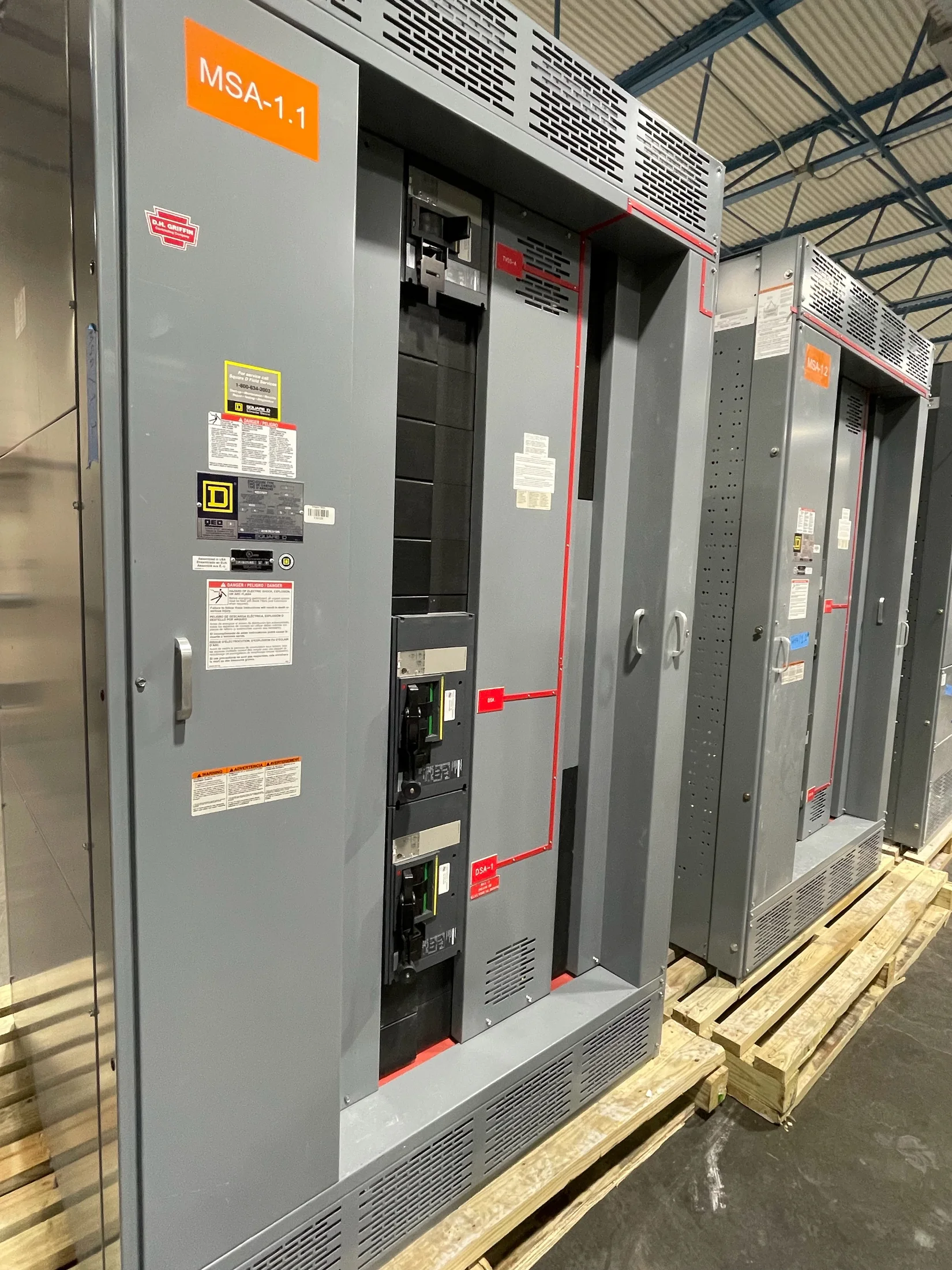
Start with the replacement scope
A breaker replacement project may mean replacing one breaker, a complete lineup, or the distribution assembly around it. New switchgear is not automatically a physical or electrical drop-in for legacy equipment. Define the scope first: identify the loads served, the equipment being retired, and whether existing bus, feeders, controls, and enclosure sections are intended to remain.
For a new lineup, document why the existing breaker arrangement no longer meets operating, maintenance, capacity, or reliability needs. That context helps determine whether the design should preserve circuit functions, change feeder organization, or accommodate future loads. Have the responsible engineer establish the project basis and review proposed changes before equipment selection.
Measure the installation, not just the old breaker
Record the existing lineup’s overall width, height, and depth, section widths, door clearances, and available working space. Note ceiling height, overhead obstructions, floor elevation, access routes, and the path from receiving point to electrical room. A new enclosure may fit the room yet prove difficult to move through doors, corridors, or turns.
Measure conduit and cable entry locations, bus duct interfaces, and distances to walls or adjacent equipment. Photograph nameplates, interior connections, and the surrounding room, then verify dimensions in the field. Old drawings are useful references, not substitutes for current measurements; renovations and past modifications can make the installed arrangement differ from records.
Identify the equipment and its standards
Gather manufacturer, catalog, and nameplate information for the existing assembly and breakers, including voltage, current, interrupting or withstand data where marked, and control-power details. Record breaker type, frame and trip information, pole count, mounting style, and any drawout features. These details support evaluation, but do not establish that a new breaker will fit or be compatible.
Confirm the equipment class and applicable standard with the project engineer. UL 891 applies to low-voltage switchboards; UL 1558 applies to low-voltage switchgear. Neither should be confused with medium-voltage equipment, which has different equipment classifications and design considerations. The selected standard and construction must suit the actual application and project requirements.
Check ratings and protection coordination
Specify system voltage, phase, frequency, available fault current, and the required continuous current and short-circuit ratings. Confirm the utility source and transformer information, grounding arrangement, and any changes to the distribution system. A rating copied from the old nameplate may not reflect present fault conditions or the performance required for the replacement installation.
Review breaker trip functions, sensor or rating plugs, ground-fault requirements, coordination objectives, and upstream and downstream protective devices. Protection settings and selectivity depend on the complete system, not the breaker alone. The responsible engineer should verify calculations and settings, including any arc-energy mitigation objectives, against the current one-line diagram and applicable project rules.
Resolve bus and connection interfaces
Determine whether the replacement will connect to existing bus duct, feeder cables, or other equipment, or instead replace those interfaces as part of a broader installation. Document bus material and dimensions where accessible, phase arrangement, neutral and ground provisions, connection orientation, and termination details. Similar current ratings do not prove that existing and new bus connections align or are electrically suitable.
For cable connections, report conductor count, size, material, insulation, lug requirements, and direction of entry. Confirm conduit locations and whether existing conductors have enough length and bend space for the proposed termination. Where reuse is contemplated, the engineer and installer should assess conductor condition, ampacity, termination compatibility, and code requirements before finalizing the configuration.
Plan the lineup and room constraints
Translate the circuit schedule into a proposed lineup: main device, feeder breakers, spare or future provisions, metering, control compartments, and any required auxiliary sections. Identify which functions must remain available and which can change. Breaker frame sizes and compartment arrangements affect section width and depth, so the circuit list should be settled before a dimensional layout is treated as final.
Consider maintenance access, door swing, ventilation, cable bending space, working clearances, and any room conditions that could affect the enclosure specification. Seismic, environmental, special enclosure, or unusual access requirements should be confirmed for the specific site rather than assumed. The engineer, contractor, utility, and AHJ may need to review relevant design and installation details.
Prepare useful information for a quote
A quote request is more actionable when it includes the current one-line diagram, circuit schedule, nameplate photographs, measured room and lineup dimensions, cable and bus connection details, and the requested equipment standard. Add required ratings, control voltage, metering needs, enclosure conditions, and the desired replacement scope. Mark unknown values clearly instead of treating estimates as verified specifications.
Include project location in Youngstown, delivery access, installation sequence, outage constraints, and the expected division of work between equipment supply and field installation. Note whether engineering documents or approval submittals are required and identify the decision-makers for technical questions. Complete information helps assess a custom-built new lineup and identify interface questions before fabrication planning proceeds.
Coordinate the transition and final design
A replacement often depends on outage planning, demolition, temporary power, feeder reconnection, and commissioning by qualified field personnel. Establish who verifies existing conditions, removes legacy equipment, adapts conductors or conduit, and checks protection settings. A new assembly does not by itself establish compatibility with retained components or confirm that the installation is ready to energize.
For Youngstown projects and shipments nationwide, the manufacturer builds new equipment in the United States using American components, with custom fabrication, short lead times, and nationwide shipping. Confirm the schedule and shipping requirements for the actual build. Before release, have the responsible engineer review ratings, dimensions, interfaces, and drawings, with utility and AHJ review where applicable.