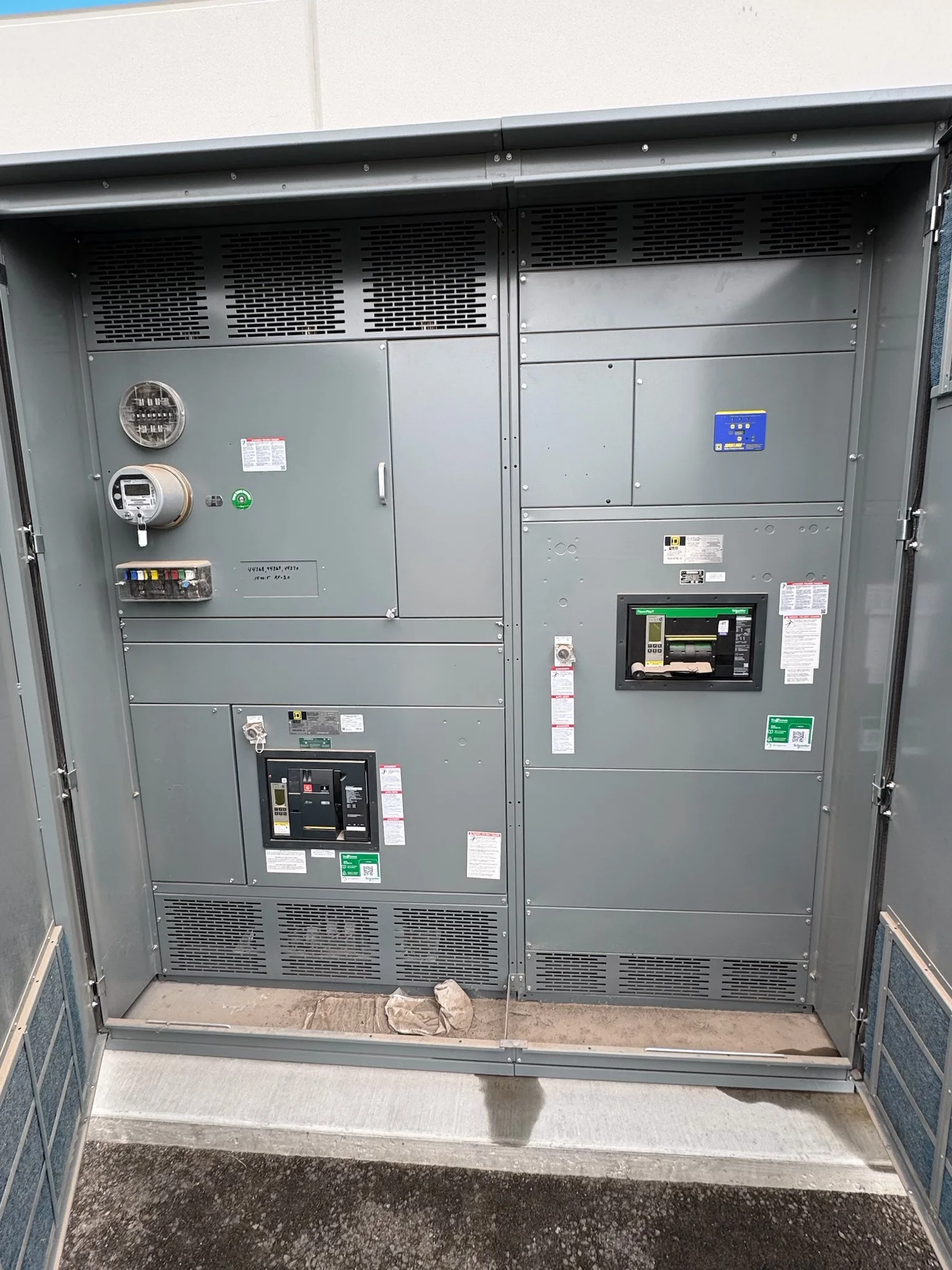
Start with the service location and exposure
An outdoor service location in Youngstown should be evaluated for more than rainfall. Confirm whether equipment faces prevailing wind, blowing snow, road splash, roof runoff, or areas where ice can accumulate. Nearby industrial processes, vehicle traffic, and landscaping may add dust, impact, or chemical exposure that affects enclosure selection and placement.
Provide site photographs, a location plan, and the proposed mounting surface when developing the equipment scope. Note clearances, access routes, nearby doors, and any overhead protection. The responsible electrical engineer should determine applicable environmental ratings and installation requirements; the enclosure designation and construction must match actual exposure rather than a generic description of “outdoor.”
Choose enclosure construction for the site
Enclosure material and finish influence corrosion resistance, weight, fabrication, and maintenance. Consider whether the installation is near deicing-salt spray, process chemicals, or areas regularly washed down. Confirm door arrangement, hardware, gasketing, and provisions for conduit entry with the manufacturer, while avoiding assumptions that a particular material or finish is suitable for every Youngstown site.
Also evaluate sun exposure and seasonal temperature conditions. Internal heating, ventilation, or other temperature-management provisions may be relevant, but they depend on equipment losses, ambient conditions, and the selected components. Share expected operating conditions and any restrictions on openings. The final design should preserve the required enclosure integrity and be reviewed for the specific installation.
Define the service disconnect arrangement
Identify the service voltage, phase, wire configuration, available service capacity, and required disconnect functions early. The project may call for a main disconnect, multiple service disconnects, or a particular arrangement of overcurrent devices, but the applicable code, utility rules, and engineered one-line diagram determine the correct configuration. Do not assume a standard layout will satisfy the service entrance requirements.
Confirm the number and type of outgoing feeders, anticipated loads, fault-current information, and any future provisions the owner wants considered. These details affect bus and device selection, compartment layout, and physical dimensions. The responsible engineer should verify ratings and coordination requirements against the site electrical system; the manufacturer can then develop a buildable configuration from the approved design basis.
Coordinate the utility metering interface
Metering is a utility interface, not simply a space reserved in the enclosure. Before defining the equipment, obtain the serving utility’s current requirements for meter location, socket or instrument-transformer arrangement, access, sealing, wiring, and service disconnect coordination. Requirements can vary by service type and project, so confirm them for the specific Youngstown address rather than relying on a prior installation.
Clarify whether the utility requires a customer-furnished or utility-furnished metering component, and establish who supplies each item. Provide the utility service documents and any approved metering sketches with the quote request. The equipment layout should allow the required access and separation while coordinating meter provisions with the service entrance and downstream distribution.
Check fault current and system constraints
Request the utility’s available fault-current information at the service point and confirm the planned transformer or source characteristics. Those inputs affect equipment withstand and interrupting requirements, protective-device selection, and the engineer’s review of the overall system. A project should not proceed on an assumed fault-current value when the utility has not confirmed it.
The one-line diagram should identify grounding and bonding approach, conductor entry, neutral treatment, and any transfer or alternate-source equipment in scope. These conditions can change the service section arrangement and required barriers. The manufacturer can fabricate to the project documents, but the responsible engineer must establish and verify the electrical design against applicable codes and site conditions.
Plan access, mounting, and weather protection
Outdoor equipment needs workable access for installation, operation, inspection, and maintenance. Confirm working clearances, door swing, service-side approach, mounting elevation, foundation or housekeeping pad, and the route for incoming and outgoing conductors. Consider snow removal and drainage so routine site work does not obstruct access or direct water toward cable entries.
A canopy or other architectural protection may reduce direct exposure, but it does not replace appropriate enclosure selection or utility clearances. Verify that protection will not interfere with ventilation, door operation, meter reading, or required working space. Include site elevation and mounting details in the project package so dimensions and entry locations can be coordinated before fabrication.
Prepare a complete quote package
A useful request for quote includes the one-line diagram, service voltage and capacity, utility metering requirements, fault-current data, enclosure exposure, and site dimensions. Add the requested disconnect and feeder schedule, conductor entry direction, available space, and any owner-specific documentation or labeling requirements. Identify what is final, pending utility approval, or still subject to engineering review.
For custom fabrication, also state the preferred equipment footprint, mounting method, shipping destination, and target project milestones. The manufacturer builds new equipment in the United States using American components and supplies customers in Ohio and nationwide. Short lead times may be available, but schedule depends on approved scope, component availability, and design coordination.
Confirm approvals before release
Before releasing a design for manufacture, reconcile equipment drawings with the utility’s metering requirements, the responsible engineer’s documents, and the authority having jurisdiction. Confirm service disconnect details, enclosure exposure, cable routing, working clearances, and any required field connections. Resolve open questions in writing so changes do not emerge after the equipment layout is established.
The equipment category must match the application. UL 891 applies to switchboards and does not cover medium- or high-voltage equipment; UL 1558 addresses low-voltage switchgear. The required construction and any applicable listing or approval must be confirmed for the particular build and project. Do not infer a specific approval from a general product description.