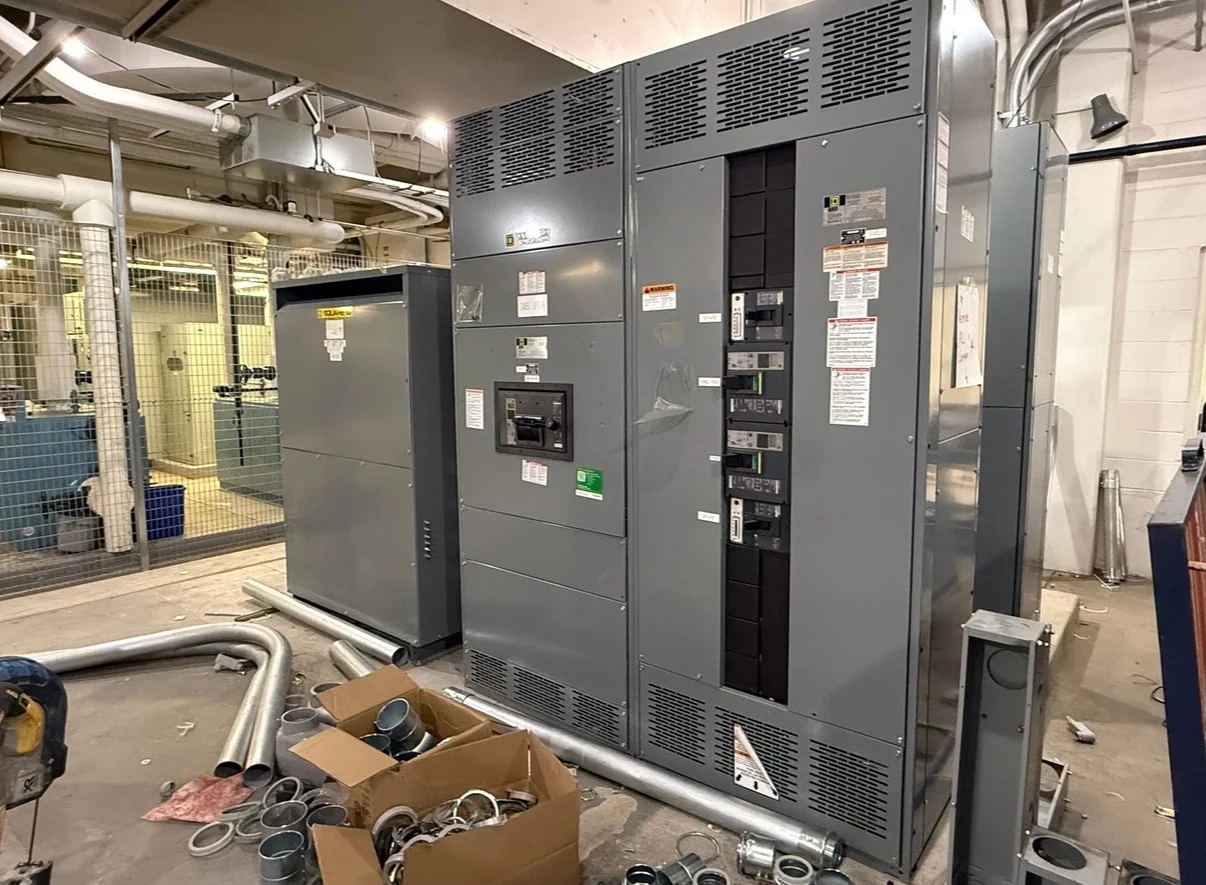
Start with the site, not the old drawings
For a Youngstown replacement or expansion, begin by checking the installation as it exists today. Drawings may predate feeder changes, room alterations, or additions made during earlier shutdowns. A field survey should record equipment lineup length, height and depth; aisle and doorway clearances; access routes; and nearby piping, ductwork, cable tray, and structural obstructions.
Capture nameplate information and clear photographs, but do not treat photographs as dimensional records. Confirm wall conditions, floor elevation, housekeeping pads, anchoring locations, overhead working space, and the path for removing and setting equipment. Qualified personnel should perform surveys using the facility’s safety procedures; energized equipment must not be approached or opened without appropriate authorization.
Establish the available fault current
Fault-duty selection depends on the electrical system, not the city name or a previous lineup’s label alone. Obtain the utility’s current source data where applicable, transformer ratings and impedance, conductor lengths and sizes, and the one-line diagram. Include generator, motor, and other sources that can contribute to fault current under relevant operating configurations.
Ask the responsible engineer to calculate available fault current at the proposed equipment terminals and evaluate the applicable ratings and protective-device coordination. Record the study date, assumptions, and normal and alternate configurations. Utility changes, transformer replacement, or tie operation can alter duty; confirm those conditions rather than carrying forward an unsupported value.
Choose the equipment class and application
Define whether the project needs a low-voltage switchboard, low-voltage switchgear, or medium-voltage equipment. UL 891 applies to switchboards, while UL 1558 applies to low-voltage switchgear; neither standard should be used to describe medium-voltage equipment. The system voltage, current, fault duty, operating needs, and project specification guide the selection.
For a new lineup, identify the incoming source, bus arrangement, feeder count, breaker or fusible-switch requirements, metering, control power, and intended expansion. Confirm whether service-entrance construction, specific devices, enclosure details, or other project features are required and available for the build. Do not assume a feature or listing applies without review of the specified configuration.
Map retrofit interfaces before fabrication
A practical retrofit plan documents what must connect to the new equipment and what will remain. Identify feeder and control-cable entry points, conductor material and sizes, lug requirements, conduit locations, grounding connections, and any bus or transition interfaces. Record phase sequence and neutral and ground arrangements, then have the design checked against the existing system.
Do not assume a new lineup will match the footprint, bus geometry, or termination space of another manufacturer’s equipment. Where existing conductors are to be reused, confirm their condition, length, bend radius, and ampacity suitability. A transition section or revised cable routing may be necessary; determine that scope before drawings are approved and equipment is released.
Plan room access and replacement sequence
Youngstown facilities may have tight electrical rooms or constrained delivery routes, so measure the complete path from unloading point to final position. Verify door and corridor widths, turns, floor loading, lift capacity, overhead limits, and space for staging. Sectionalized construction may help with handling, but its dimensions, joints, and assembly access must be confirmed for the project.
Build the shutdown plan with facility operations and the electrical contractor. Identify loads that require temporary power, outage windows, demolition limits, isolation points, and commissioning responsibilities. Confirm whether old equipment can be removed in sections and whether new sections can be installed without disrupting adjacent live gear; the site plan and safety controls govern the sequence.
Specify protection, controls, and metering
Protection choices should follow the system study and operating objectives. Provide the desired breaker or switch functions, trip-unit requirements, protective settings responsibility, selective-coordination criteria, and any ground-fault requirements. Confirm interrupting and withstand ratings against calculated duty. Settings and coordination should be reviewed by the responsible engineer, not inferred from the equipment schedule.
List metering points, communications protocols, control voltages, interlocks, alarms, and remote-operation needs as project requirements. State which devices and wiring are in scope and identify connections to building controls or supervisory systems. If the project has utility, owner, or specification requirements for these functions, provide the documents for review before the configuration is finalized.
Prepare a quote package that supports review
A useful request for quotation includes the one-line diagram, equipment schedule, available fault-current or short-circuit study, and written specifications. Add field dimensions, photos, nameplate records, cable and conduit entry details, and the intended retrofit boundary. Include delivery constraints, required submittal information, and any known outage or installation milestones.
Identify uncertainties explicitly: missing fault data, inaccessible dimensions, pending utility information, or unresolved feeder reuse. The manufacturer can review the supplied basis and develop a custom-fabricated new-equipment proposal, but assumptions should be visible for engineering approval. Confirm final drawings, interfaces, and project-specific requirements before release to manufacture.
Coordinate delivery, installation, and acceptance
Equipment is built in the United States with American components and can be configured through custom fabrication for the approved project requirements. Short lead times may be available, but schedule depends on the final design, component availability, approvals, and scope. Nationwide shipping supports Youngstown-area projects; confirm shipment configuration, unloading responsibility, and receiving conditions.
Before energization, the installing contractor and responsible engineer should verify installation, terminations, grounding, clearances, labels, settings, and required inspections against approved documents and applicable codes. Coordinate utility review and AHJ requirements where relevant. Send the final one-line, specifications, fault-duty basis, field survey, and schedule constraints to begin a project-specific equipment discussion.