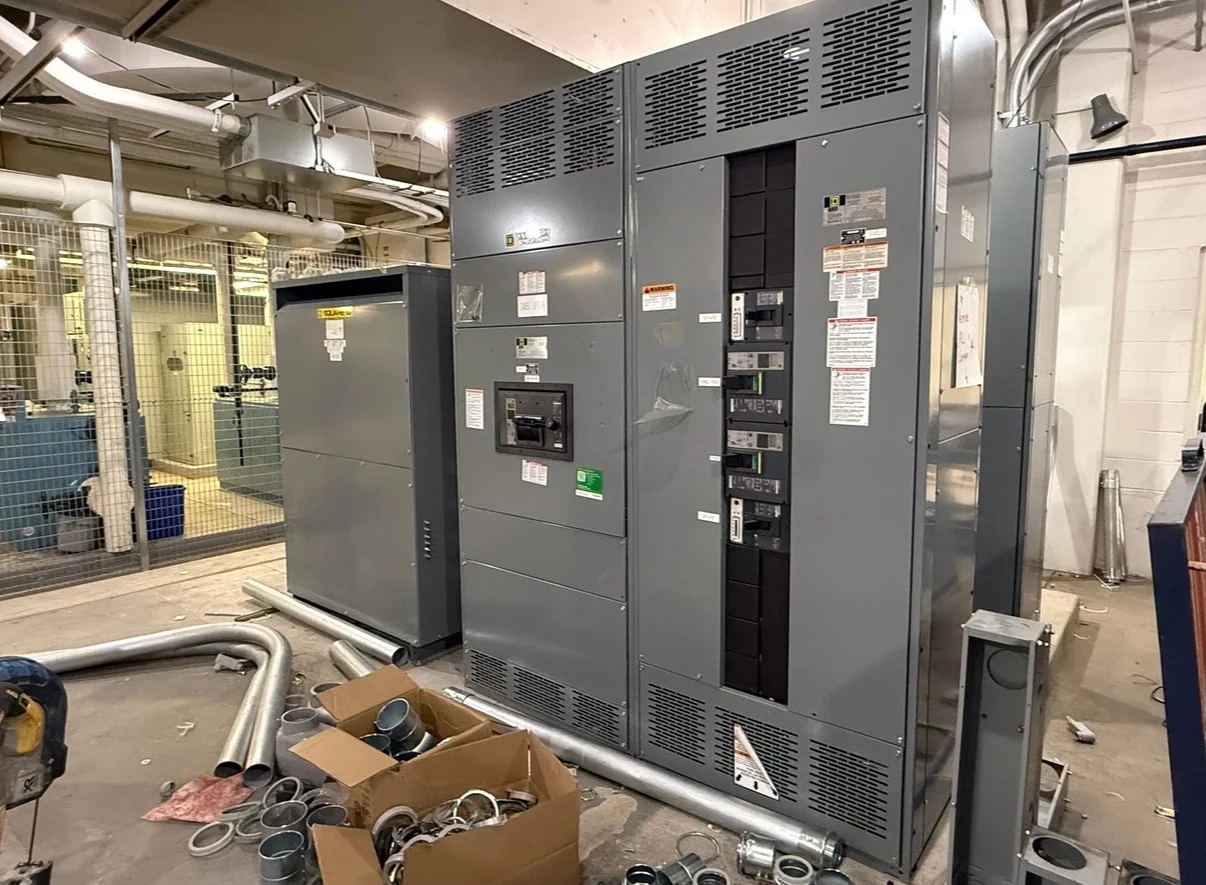
The Voltage Label Is Not the Whole Answer
In a common 480Y/277 V system, 480 volts is measured phase to phase, while 277 volts is measured from any phase to the grounded neutral point. That arrangement can serve three-phase equipment at 480 V and lighting or other single-phase loads at 277 V. The voltage designation alone, however, does not prove a neutral must enter every switchboard or distribution section.
A 480 V load connected only phase to phase may not use a neutral conductor. Whether the equipment should include a neutral bus, neutral terminal, or neutral feeder depends on what it supplies and how the source is configured. Confirm the one-line diagram and load schedule rather than inferring conductor needs from a nameplate voltage.
Start With the Source Connection
Determine whether the source is a grounded wye system with a usable neutral, a delta system, or another arrangement. A grounded wye source provides a neutral point; a delta source generally does not provide the same neutral reference, although specific grounding and transformer configurations can affect what conductors are available downstream. Verify the actual source and grounding method.
Also establish where the neutral is first made available and how the service or separately derived system is grounded and bonded. The equipment connection must preserve the intended grounding and bonding scheme. Ask the responsible electrical engineer or utility to resolve source details that are uncertain; do not assume a neutral can be added simply by installing a bus.
Inventory the Loads That Need Neutral
List each outgoing load by voltage, phase, and connection. Three-phase motors and many other 480 V loads use phase conductors without a neutral, while 277 V lighting circuits typically require a phase conductor and neutral. Control power, receptacles, electronic equipment, and auxiliary circuits may also need a neutral, depending on their specified voltage and supply method.
Account for present loads as well as planned circuits, spare capacity, and likely building changes. A panel serving only 480 V loads today may later supply 277 V lighting, but future flexibility should be an explicit design decision. Identify load balance and nonlinear loads for engineering review; neutral current and conductor sizing cannot be determined from the system voltage label alone.
Choose the Right Equipment Configuration
For new switchgear or a switchboard, the specification should say whether a neutral bus is required, its intended connection, and which sections or feeders need neutral terminals. A neutral bus may extend through equipment even when some outgoing circuits are three-wire. Conversely, an assembly built for three-phase, three-wire distribution should not be presumed suitable for later neutral-dependent loads.
Describe the required incoming and outgoing conductor arrangements, including phase, neutral, and equipment grounding conductors where applicable. Confirm neutral bus location, termination provisions, and any section-to-section connections with the equipment drawings. These details are project-specific and should be coordinated with the service design, available fault information, and the selected equipment type and ratings.
Coordinate Metering and Instrumentation
Metering needs can affect whether a neutral connection is required at the equipment. Some measurement schemes use phase-to-phase voltage references; others measure phase-to-neutral voltage or monitor neutral current. The utility’s metering rules, the specified meter and instrument transformers, and the desired monitoring functions determine the needed connections and terminals.
Provide the metering diagram and identify whether revenue metering, branch monitoring, ground-fault functions, or other instrumentation is part of the scope. Do not assume that a neutral is needed merely because a meter is present, or that it is unnecessary because loads are mostly three-phase. Have the engineer and utility confirm the arrangement before drawings are finalized.
Grounding and Protection Are Separate Questions
A neutral is a grounded circuit conductor when used as the system neutral; an equipment grounding conductor serves a different purpose. They are not interchangeable, and the neutral should not be treated as a substitute for equipment grounding. The permitted bonding point and conductor routing depend on whether the equipment is service equipment or supplied downstream.
Protection settings and grounding methods also affect the design, but they do not create a neutral requirement by themselves. Confirm the system grounding method, ground-fault protection requirements, bonding locations, and applicable code provisions with the responsible engineer and authority having jurisdiction. Incorrect assumptions can lead to incompatible equipment connections or an installation that does not match the approved design.
Information to Provide for a Quote
For a useful equipment quote, provide the nominal system voltage and source configuration, a one-line diagram, service or feeder conductor count, and the grounding method. Include the load schedule with voltage and phase for each load, expected future circuits, bus requirements, incoming and outgoing arrangements, and any specified metering or monitoring functions.
Also identify the equipment type and applicable specification, required sections, enclosure and installation conditions, available fault-current information, and project schedule. If the neutral requirement is unresolved, state that clearly and request coordination rather than selecting an assumption. A U.S. manufacturer can review the stated scope for custom fabrication and nationwide shipment of new equipment.
Confirm the Design Before Release
Before approving submittals, compare the equipment drawings with the engineer’s one-line, load schedule, grounding and bonding details, and metering documents. Verify that every neutral-dependent load has a defined neutral path and that three-wire circuits are not assigned terminals or conductors they do not require. Resolve discrepancies before fabrication to avoid field changes.
The final answer is project-specific: 277/480 V equipment needs a neutral when the source and distribution design require one for connected loads, metering, or other specified functions. It may not need one for a strictly three-phase, three-wire application. The responsible engineer, utility, and AHJ should confirm the design where their review applies.